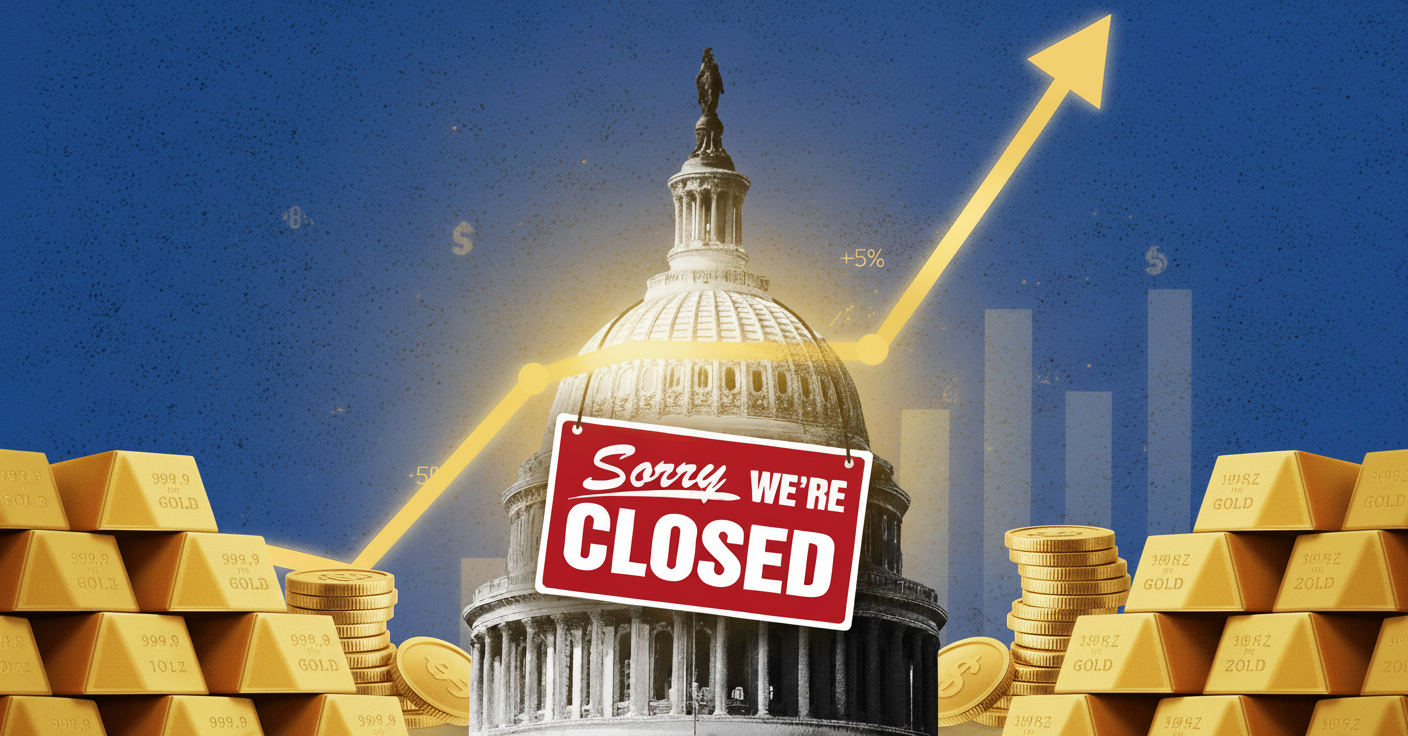
The federal government shut down for the first time in almost seven years, and gold responded exactly the way it always does when uncertainty strikes.
It soared to a fresh all-time high of $3,894.63 per ounce.
This wasn't just another record. It was the 39th record high gold has hit this year alone. And if you've been watching the news, you know exactly why.
Why Did Gold Hit Record Highs During the Government Shutdown?
Congress failed to reach a deal on government funding, and now hundreds of thousands of federal workers are furloughed. Critical economic data, including Friday's jobs report, has been delayed. President Trump has threatened to use this shutdown to cut federal employees permanently.
And nobody knows how long this will last. During Trump's first term, we saw a 35-day partial shutdown, the longest in American history.
The timing couldn't be worse. The Federal Reserve is trying to navigate monetary policy without key employment data. Markets are jittery. And the political gridlock in Washington is exposing just how fragile our system really is when both parties refuse to compromise.
But here's what's really important. This shutdown isn't happening in a vacuum. It's just the latest symptom of a much deeper problem that's been building for years, and smart investors have been paying attention.
Central Banks Are Buying Gold at Historic Rates
Gold didn't hit record highs by accident. Central banks around the world have been accumulating gold at a pace we haven't seen since the 1970s. According to the World Gold Council, central banks have purchased over 1,000 tonnes of gold annually for the past three years. That's more than double the 400 to 500 tonnes they were buying in the decade before.
Think about that for a moment. The world's most sophisticated financial institutions, the ones with access to every piece of economic data and every investment option imaginable, are choosing to buy physical gold in record amounts. In fact, it's a global gold rush right now.
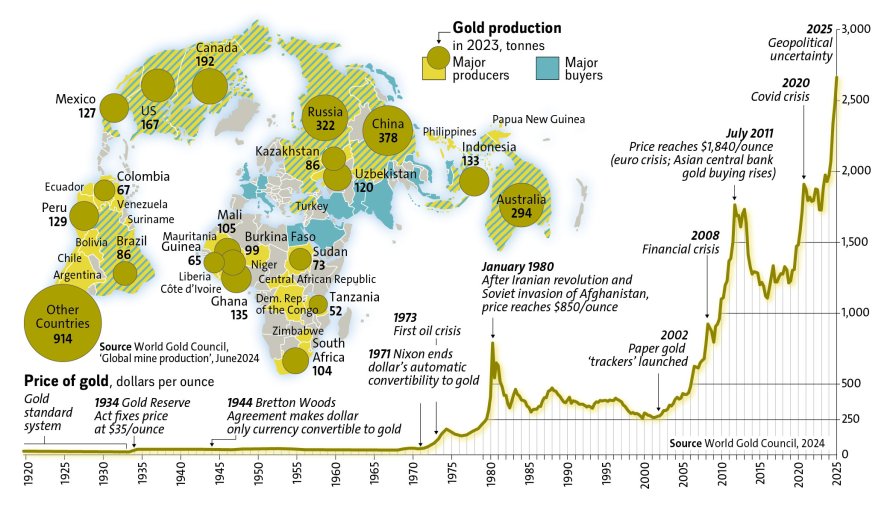 These aren't emotional decisions. Central banks don't panic buy. They're making calculated moves based on what they see coming. And what they see is a global financial system under unprecedented stress.
The Dollar's Declining Dominance
The U.S. dollar's share of global reserves has fallen from over 70% in 2000 to roughly 58% today. Meanwhile, gold's share has nearly doubled. Countries are quietly but deliberately reducing their dependence on dollar-denominated assets, and they're turning to the one asset that can't be frozen, sanctioned, or devalued by another country's central bank.
The shutdown we're seeing today is just one more reason why. When the world's largest economy can't even keep its own government funded, when political dysfunction prevents basic governance, when the national debt continues climbing past $37 trillion with no end in sight, other nations take notice. They start asking themselves a very simple question: Do we really want to keep all our reserves in dollars?
The answer, increasingly, is no. And that's why 95% of central bankers surveyed believe global gold reserves will continue to increase over the next 12 months. A record 43% said their own central bank plans to increase gold holdings this year.
What Experts Are Saying About Gold's Future
This is the kind of information that doesn't make headlines, but it should. Because when central banks move in unison like this, they're telling us something. They're preparing for a world where the old rules don't apply anymore. Where geopolitical tensions, currency instability, and government dysfunction are the new normal.
Michael Field, chief equity strategist at Morningstar, put it perfectly when he told CNBC that the shutdown was "just the straw that broke the camel's back." He pointed to two major ongoing conflicts, political instability in France, newly announced tariffs, and a general atmosphere of instability. "When the going gets tough, gold gets a boost," he said.
Is $4,000 Gold on the Horizon?
But it's not just about crisis protection anymore. Philippe Gijsels, chief strategy officer at BNP Paribas Fortis, believes gold is heading well past $4,000 per ounce. He noted that gold and gold-related investments make up barely 2% of the average investment portfolio worldwide. "To say it in baseball terms, we are only in the second or third inning," he said. "$4,000 will not be the endpoint, just the start of the strongest bull market in precious metals the world has ever seen."
That's a bold statement, but the fundamentals back it up. With the Fed's easing cycle underway, dollar weakness on the horizon, and central banks continuing to accumulate gold at historic rates, the conditions are in place for gold to move significantly higher.
UBS Strategist Joni Teves echoed this sentiment in a note to clients, stating: "We expect gold's bull run to continue over the coming quarters, driven by rising investor positions and a continued broadening in gold's investor base. With the Fed easing cycle under way, dollar weakness and declining real rates should be bullish for the gold price."
Why Gold Is the Ultimate Safe Haven Asset
The question isn't whether gold will continue rising. The question is whether you're positioned to benefit from it.
Most Americans still have their retirement savings sitting in traditional assets: 401(k) plans, IRAs, TSP accounts, stocks, bonds, or just cash in a savings account. These are the same assets that lose value when inflation rises, when the dollar weakens, when markets panic, and when governments shut down.
Gold's Performance During Economic Uncertainty
Gold does the opposite. It gains value precisely when everything else is falling apart. That's why it's called a safe haven. That's why central banks are buying it. And that's why investors who understand what's really happening are moving a portion of their retirement savings into physical gold.
According to the World Gold Council's 2025 Central Bank Gold Reserves Survey, the key reasons central banks hold gold include:
- Performance during times of crisis: Gold maintains value when other assets decline
- Effective portfolio diversification: Low correlation with other reserve assets
- Inflation hedge: Protects purchasing power during periods of rising prices
- No counterparty risk: Physical gold is not dependent on any institution's solvency
- Store of value: Proven track record spanning thousands of years
How to Protect Your Retirement Savings With Gold
You don't have to predict the next crisis to benefit from gold. You just have to recognize that we're living in a world where crises are becoming more frequent, more severe, and more unpredictable. A world where a government shutdown can happen overnight. Where inflation can spike without warning. Where geopolitical tensions can escalate in a matter of days.
Gold is the one asset that thrives in that environment. It's been a store of value for thousands of years, and it's proving its worth once again right now.
Gold Investment Options for Americans
There are several ways to add gold to your retirement portfolio:
- Physical gold bullion: Coins and bars you can hold
- Gold IRAs: Tax-advantaged retirement accounts backed by physical gold
- Gold-backed securities: ETFs and other paper gold instruments
- Precious metals diversification: Including silver, platinum, and palladium
The most secure option for long-term wealth preservation is physical gold held in a tax-advantaged retirement account, which combines the benefits of gold ownership with the tax advantages of traditional retirement planning.
The Bottom Line: Gold's Historic Rally Is Just Beginning
With 39 record highs already this year, gold's performance in 2025 has been nothing short of extraordinary. But according to experts and the actions of central banks worldwide, this may only be the beginning.
The combination of government dysfunction, rising national debt, geopolitical uncertainty, dollar debasement, and record central bank buying creates a perfect storm for continued gold price appreciation. As Philippe Gijsels noted, we're "only in the second or third inning" of what could be the strongest bull market in precious metals history.
The government shutdown that triggered yesterday's record high is just one more data point in a larger trend. Smart investors are recognizing that trend and taking action to protect their retirement savings before gold moves even higher.
Frequently Asked Questions
Why does gold go up during government shutdowns?
Gold rises during government shutdowns because it's viewed as a safe haven asset during times of uncertainty. When political dysfunction creates economic instability, investors move capital into gold to protect their wealth.
How high can gold prices go in 2025?
Analysts predict gold will surpass $4,000 per ounce by 2026, with some experts believing we're in the early stages of a historic bull market. Central bank buying and economic uncertainty support continued price appreciation.
Should I move my 401(k) into gold?
Many financial advisors recommend diversifying retirement portfolios with 10-20% in precious metals. A Gold IRA allows you to hold physical gold in a tax-advantaged retirement account while maintaining diversification.
What percentage of my portfolio should be in gold?
Most experts recommend allocating 10-20% of your investment portfolio to gold and precious metals for optimal diversification and protection against economic uncertainty.
Is now a good time to buy gold?
With gold hitting record highs and central banks continuing to buy at historic rates, many experts believe gold has significant room to grow. However, gold should be viewed as a long-term strategic holding rather than a short-term trade.