Markets Dumping - Are Cracks Forming In The AI Bubble?
When the Market Stops Making Sense
You know that feeling when something just doesn't add up?
Well, that's exactly what just happened on Wall Street. And people everywhere are confused as they see the markets dumping.
The Dow swung over 1,100 points in a single day, its biggest swing since April. Nvidia, the chipmaker that's been the poster child of the AI revolution, reported earnings that were better than expected. The stock initially jumped 5%.
Then something strange happened. By the close, it was down over 3%.
Bitcoin, which had been trading above $124,000 just weeks ago, crashed below $82,000. That's a 24% drop in a month.
UBS economist Paul Donovan didn't mince words when he said that if you annualize Bitcoin's recent collapse, it's equivalent to roughly 800% inflation. His conclusion? This is why crypto cannot be a currency.
The Broader Market Selloff: More Than Just a Bad Day
But let's go deeper. Because this wasn't just one or two stocks having a bad day. This was broad-based selling across artificial intelligence companies, cryptocurrency stocks, and tech giants that have been driving the entire market higher for the past two years.
The VIX volatility index, often called Wall Street's fear gauge, spiked to its highest level since April. CNN's Fear and Greed Index dropped into extreme fear territory. Almost $1.5 trillion gone in a day.
What Spooked Investors?
So what spooked investors so badly that they dumped the very stocks they'd been piling into for months?
The answer is actually pretty simple. They started asking questions they should have been asking all along. Questions like:
Can these companies actually justify their sky-high valuations?
Is the artificial intelligence boom sustainable?
And most importantly, when will all this spending actually turn into profits?
The OpenAI Problem: When the Math Doesn't Add Up
Consider this. OpenAI, the company behind ChatGPT, is valued at $500 billion. Yet it's losing billions of dollars every year.
The company committed to spending $300 billion with Oracle over the next five years for computing power. That's $60 billion per year. Their projected revenues for 2025? Just $13 billion. The math simply doesn't work.
Circular Financing: A House of Cards?
Then there's the circular financing that's starting to look more than a little suspicious. Nvidia invests $100 billion in OpenAI. OpenAI uses that money to buy Nvidia chips and pay Oracle for data centers. Oracle uses that money to buy more Nvidia chips. Nvidia's investment in OpenAI goes up in value.
And round and round it goes.
An MIT study released in August found that despite $30 to $40 billion in enterprise investment into generative AI, 95% of organizations are getting zero return on investment. Zero.
Warning Signs From Financial Leaders
The Bank of England issued a warning in October about the growing risks of a global market correction due to possible overvaluation of leading AI tech firms. They specifically noted that investors weren't being properly cautioned about the risks of a stock market crash if AI falls short of market expectations.
Goldman Sachs CEO David Solomon said he expects there to be a lot of capital deployed that doesn't deliver returns. Amazon founder Jeff Bezos called the current environment kind of an industrial bubble.
Even OpenAI's own CEO, Sam Altman, warned that people will overinvest and lose money during this phase.
AI Is Real, But That Doesn't Mean These Valuations Are
Now, we're not saying that artificial intelligence isn't real or that it won't change the world. It very likely will. But there's a big difference between a technology being transformative and the companies building that technology being good investments at any price.
Lessons From the Dot-Com Bubble
History has taught us this lesson before. During the dot-com bubble, the internet was absolutely going to change everything. And it did. But that didn't stop the Nasdaq from losing 78% of its value between 2000 and 2002. Hundreds of companies went bankrupt.
Trillions of dollars in wealth evaporated. Especially retirement accounts.
The survivors, companies like Amazon and Google, eventually became some of the most valuable businesses in the world. But even they saw their stock prices crater by 90% or more during the crash. If you bought Amazon at the peak in 1999, it took you nearly a decade just to break even.
Dangerous Market Concentration in 2025
Here's the concerning thing. The concentration of wealth in just a handful of stocks has reached levels we haven't seen since the dot-com bubble.
As of late 2025, 30% of the S&P 500 is held up by just five companies. The S&P 500's price-to-earnings ratio based on trailing 10-year earnings is now around 40 times, comparable to dot-com peak levels.
When you have that much concentration, when that much of the market's value is tied up in a single narrative, you're vulnerable. Very vulnerable.
The Ripple Effect Through Financial Markets
And it's not just tech stocks. This kind of instability ripples through the entire financial system. When investors start questioning the valuations of the market's biggest winners, they start questioning everything.
Confidence evaporates. Money that was chasing returns suddenly becomes money looking for safety.
Why Gold Outperforms During Market Uncertainty
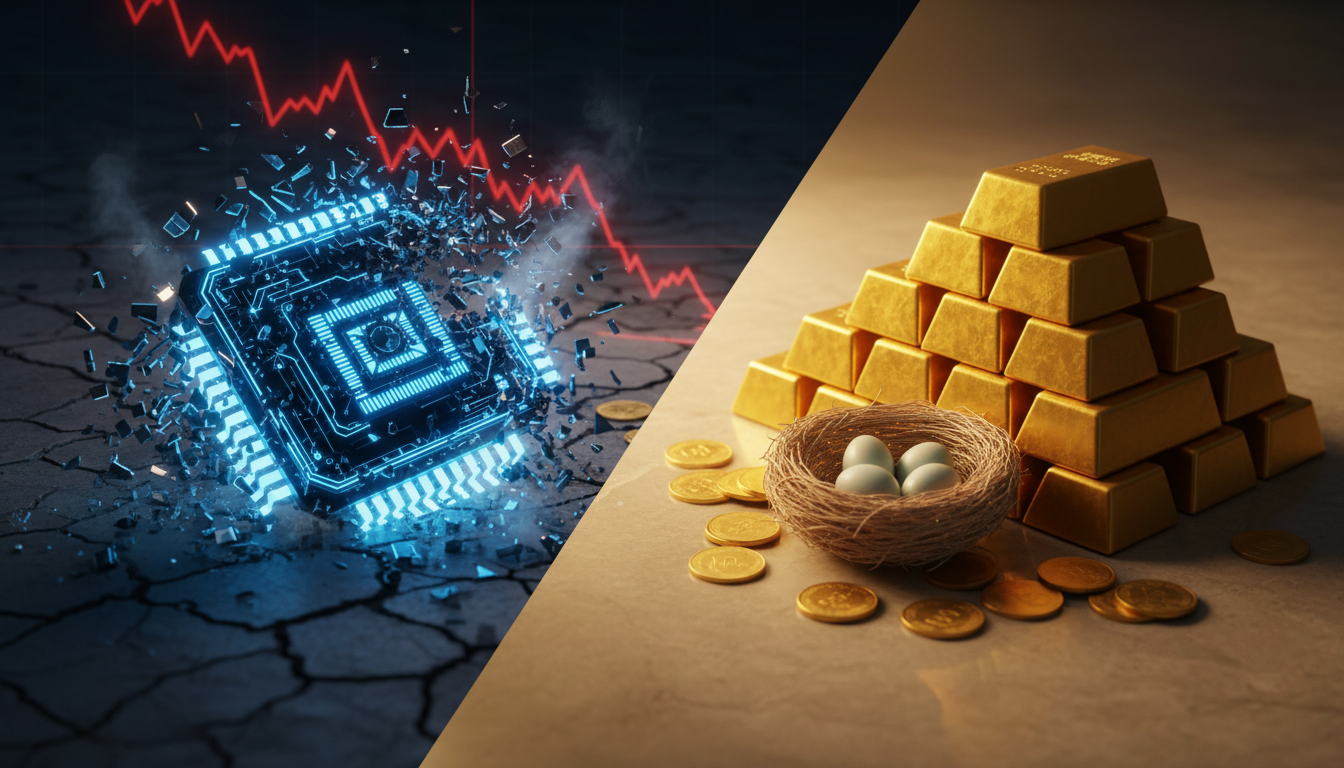
This is exactly the kind of environment where gold has historically shined and outperformed every other asset class.
Gold doesn't promise revolutionary returns. It doesn't have a charismatic CEO making bold predictions about the future. It doesn't require you to understand complex technology or trust that circular financing schemes will somehow work out. But somehow it keeps rising when other things are falling.
What Makes Gold Different
Because what gold does is simple. It holds its value when other assets don't. It's been doing that for thousands of years, through every bubble, every crash, every period of economic uncertainty that's come along.
Central Banks Are Buying Gold at Record Levels
Central banks understand this. They've been buying gold at record levels. In 2024, central banks purchased over 1,000 tons of gold for the third consecutive year.
Countries like China, India, and Turkey have been aggressively adding to their reserves. They're not doing this because they think gold is going to double overnight. They're doing it because they understand that when the financial system gets shaky, gold is the asset you want to own.
The Dollar's Declining Reserve Status
The dollar's status as the world's reserve currency is being challenged in ways it hasn't been in decades. Countries are conducting trade in their own currencies, bypassing the dollar entirely. The BRICS nations are exploring alternatives to dollar-based payment systems.
The U.S. Debt Crisis
Meanwhile, the U.S. national debt has surpassed $38 trillion and continues climbing. With no real means to pay this debt other than inflating the economy to devalue it, because foreign countries like Japan aren't buying up our US Treasuries anymore. So the debt has nowhere to go.
Multiple Risk Factors Converging
When you combine record debt levels, geopolitical tensions, an ever-more-clearly-forming AI bubble, and extreme concentration in the stock market, you're looking at a lot of risk. More risk than most people's retirement portfolios should be exposed to.
The Case for Diversification
Of course we're not saying put everything into gold. That's not what diversification means. You need some liquidity.
But if your retirement savings are entirely in cash-backed assets, stocks, bonds, or sitting in a savings account earning interest that doesn't keep pace with real inflation, then you're on a path for bad news.
And that's not even our opinion, that's what everyone is starting to realize because the numbers are showing the patterns of what's coming.
Gold: A Tangible Store of Value
Gold offers something different. It's a tangible asset that's not dependent on any company's earnings, any government's promises, or any technology working out the way people hope it will.
It's simply valuable because it's scarce, it's durable, and people have recognized its worth for millennia.
When Wall Street's darlings start to stumble, when the narratives that drove stocks higher start to crack, that's when people remember why gold has been called the ultimate store of value.
Protect Your Retirement With Gold
At National Gold Group, our mission is to inform and educate Americans about investing in gold and other precious metals. And present you with no-pressure options that are unique to your goals.
With over 25 years of experience and a 4.9 rating across multiple 3rd party review sites like Trustpilot and Google, we're here to help you with transparent and no-hassle advice.
If you're interested in investing in gold, call us today and let's talk. We're happy to answer any questions you have.
Frequently Asked Questions About the AI Bubble and Gold Investment
Is there really an AI bubble forming in 2025?
Multiple indicators suggest an AI bubble is forming, including extreme market concentration, circular financing among tech companies, and valuations comparable to the dot-com bubble. The Bank of England and major financial leaders have issued warnings about overvaluation in AI stocks.
Why did the stock market crash $1.5 trillion in one day?
Investors began questioning whether AI companies can justify their valuations and when massive AI spending will translate to profits. Despite strong Nvidia earnings, concerns about sustainability triggered broad-based selling across tech and crypto sectors.
How does gold protect against market crashes?
Gold historically maintains or increases value during market downturns because it's a tangible asset not dependent on corporate earnings or government promises. It has served as a store of value for thousands of years across every economic crisis.
Should I move my entire retirement into gold?
No. Proper diversification means maintaining liquidity while protecting a portion of your portfolio with gold. If your retirement is entirely in stocks, bonds, or cash-backed assets, you may be overexposed to market risk.
Why are central banks buying so much gold?
Central banks purchased over 1,000 tons of gold in 2024 because they understand gold's role as a safe haven during financial instability. Countries like China, India, and Turkey are aggressively adding to reserves as the dollar's reserve status faces challenges.
How is the AI bubble similar to the dot-com crash?
Both feature extreme valuations based on future promises rather than current profits, high market concentration in a few companies, and circular financing. The S&P 500's P/E ratio is now at dot-com bubble levels (40x trailing 10-year earnings).
What's circular financing in AI companies?
Circular financing occurs when companies invest in each other in ways that artificially inflate valuations. For example: Nvidia invests in OpenAI, OpenAI buys Nvidia chips, Oracle buys Nvidia chips, and Nvidia's OpenAI investment increases in value.
Can I still invest in stocks if there's an AI bubble?
Yes, but understand the risks. Even transformative technologies like the internet saw 78% market declines during the dot-com crash. Amazon dropped 90% and took a decade to recover. Diversification with assets like gold can protect against such volatility.