Gold Price Hits $4,529 As Historic 2025 Rally Continues
Gold prices held near record highs Friday morning as investors continued pricing in Federal Reserve rate cuts and sought safe-haven assets during thin holiday trading conditions.
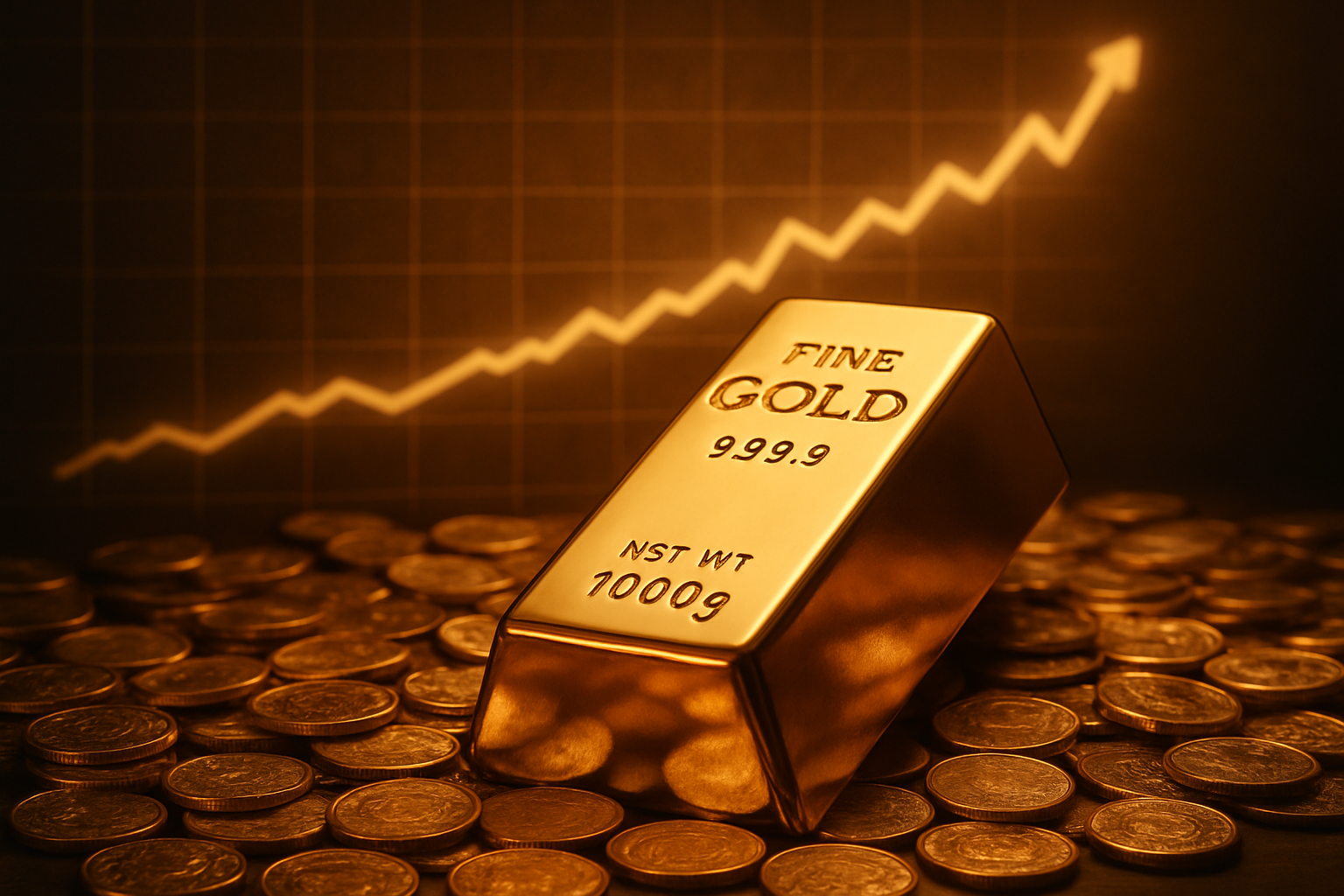
At 10:14 a.m. EST, spot gold traded at $4,529 per ounce, up approximately 1.1% on the day and within striking distance of the session's all-time high of $4,530.60.
The precious metal's extraordinary rally has extended throughout 2025, with gold prices climbing more than 72% year-to-date, marking the largest annual gain since 1979.
Gold started 2025 at approximately $2,624 per ounce on January 1, meaning the metal has added over $1,900 per ounce in less than twelve months. This performance has outpaced virtually every major asset class and represents one of the most powerful bull markets in gold's modern history.
Current Gold Price: Where Markets Stand Right Now
Gold's morning session reflects a market holding a powerful uptrend rather than experiencing parabolic acceleration:
- Spot gold price (XAU/USD): $4,529/oz at 10:14 a.m. EST
- All-time high: $4,530.60/oz (reached earlier in session)
- Year-to-date gain: +72.8%
- Monthly gain: +8.9%
Price quotes can vary by several dollars depending on timestamp, bid-ask spreads, and whether you're viewing spot prices versus futures contracts.
What's Driving Gold Prices Higher in December 2025
Today's gold price movement isn't happening in isolation. It represents the continuation of a multi-month rally driven by both macroeconomic trends and structural shifts in global gold demand.
According to Trading Economics, gold has surged more than 70% so far this year, marking its largest annual gain since 1979, with the rally underpinned by strong central bank buying and sustained ETF inflows.
Federal Reserve Rate Cut Expectations Supporting Gold
Gold typically benefits when investors anticipate lower interest rates because the opportunity cost of holding non-yielding assets decreases. Markets are currently pricing in at least two Federal Reserve rate cuts in 2026, which continues to provide fundamental support for gold prices.
Lower real yields make gold more attractive relative to interest-bearing assets like Treasury bonds. With inflation expectations remaining elevated and the Fed signaling a more accommodative stance, the real yield environment remains constructive for precious metals.
U.S. Dollar Weakness Lifting Gold Prices
A weaker U.S. dollar mechanically lifts dollar-denominated commodities like gold, making the metal cheaper for foreign buyers. The dollar has softened significantly in 2025 as markets anticipate Fed policy easing and potential changes in Fed leadership that could signal a more dovish approach to monetary policy.
Currency dynamics will remain a key driver of gold prices heading into 2026, particularly as other central banks maintain tighter policy stances relative to the Federal Reserve.
Safe-Haven Demand Amid Geopolitical Uncertainty
Gold's record-breaking session was partly driven by safe-haven demand as investors seek portfolio protection against geopolitical risks and policy uncertainty.
According to Trading Economics, investor focus remains on ongoing geopolitical tensions including the US blockade of crude shipments from Venezuela, continued hostilities between Russia and Ukraine, and recent military actions.
With multiple global flashpoints remaining unresolved and U.S. fiscal policy debates intensifying, gold continues to serve its traditional role as a hedge against uncertainty.
Central Bank Gold Buying Remains Structurally Strong
Central bank gold purchases have emerged as one of the most significant structural supports for gold prices. Global central banks have added over 1,000 tons of gold to reserves annually for three consecutive years, well above historical averages.
This buying trend accelerated after Western nations froze Russian foreign exchange reserves in 2022, prompting central banks worldwide to diversify away from dollar-denominated assets.
Central bank demand shows no signs of slowing, with institutions viewing gold as a non-confiscatable reserve asset that can't be weaponized through sanctions.
Gold ETF Inflows Returning After Multi-Year Outflows
After experiencing significant outflows in 2022 and 2023, gold-backed exchange-traded funds have seen renewed investor interest in 2025.
ETF inflows provide additional buying pressure in the physical gold market and signal that institutional and retail investors are increasing portfolio allocations to precious metals.
Thin Holiday Liquidity Amplifying Price Moves
Market conditions matter when analyzing short-term price action. With many global markets closed or operating with reduced staff during the holiday period, trading volumes are significantly lower than normal. This thin liquidity can amplify price movements in both directions, making volatility more pronounced.
Physical Gold Demand: Mixed Signals From Major Markets
While financial demand for gold remains robust, physical markets in Asia's two largest gold-consuming nations are showing divergent trends.
India Gold Demand Cools at Record Prices
Record-high gold prices have significantly dampened retail buying in India, traditionally one of the world's largest gold consumers. Local dealers are offering discounts as wide as $61 per ounce—the largest discounts in more than six months—as consumers balk at elevated price levels.
Indian gold demand is highly price-sensitive, and the current rally has pushed prices beyond the comfort zone for many jewelry buyers and retail investors. Any meaningful pullback in gold prices could quickly revive Indian physical demand.
China Gold Market Shows Resilience
In contrast to India, China's physical gold market has shown more resilience. Premiums and discounts have narrowed sharply to approximately $15-$30 per ounce, helped by speculative interest, constrained supply tied to import quotas, and favorable currency dynamics.
This divergence highlights a key tension for 2026: how much of the gold price rally is being driven by investment flows versus end-user jewelry demand. Sustained prices above $4,500 per ounce may continue to pressure physical demand in price-sensitive markets.
Silver Prices Break $75 Per Ounce, Supporting Broader Precious Metals Rally
Gold's rally is occurring alongside an even more dramatic move in silver, which topped $75 per ounce for the first time in history. Silver's breakout has drawn additional attention to the precious metals complex and reinforces the macro thesis supporting gold.
The broader "metals bid" supports gold in two ways: it validates the underlying macroeconomic drivers (rate cuts, dollar weakness, hedging demand), and it fuels momentum behavior as investors rotate within the precious metals complex.
Gold Price Forecast 2026: Where Analysts See Prices Heading
With spot gold already above $4,500 per ounce, Wall Street forecasts for 2026 have widened considerably. Several major financial institutions see continued upside, while a minority of analysts argue the rally has gone too far.
Bullish Gold Price Forecasts From Major Banks
Goldman Sachs projects gold will climb to $4,900 per ounce by December 2026 in its base case scenario, citing structurally elevated central bank demand and cyclical support from Federal Reserve rate cuts. The bank views gold as one of its highest-conviction commodity calls for 2026.
J.P. Morgan forecasts gold prices will push toward $5,000 per ounce by the fourth quarter of 2026, with $6,000 per ounce a possibility longer term. The bank expects central bank and investor demand for gold to remain strong, averaging 585 tonnes per quarter in 2026.
J.P. Morgan notes that gold prices posted continuous gains in 2025, climbing as much as 55% and surpassing $4,000/oz for the first time in October.
Morgan Stanley forecasts $4,800 per ounce by Q4 2026, expecting smaller percentage gains than 2025 but continued fundamental support from rate cuts, dollar dynamics, and persistent demand factors.
HSBC has said gold could reach $5,000 per ounce in the first half of 2026 and raised its 2026 average forecast to $4,600 per ounce. The bank warns of potential volatility and possible moderation in the second half of 2026 as some cyclical tailwinds fade.
Deutsche Bank raised its 2026 forecast to $4,450 per ounce, with a trading range of $3,950 to $4,950. The bank believes ETF flows could help establish a floor under prices even if some momentum fades.
Bank of America has issued one of the most bullish calls, suggesting gold could reach $6,000 per ounce if multiple favorable conditions align, including aggressive Fed easing and sustained geopolitical tensions.
Scenario-Based Analysis From Industry Groups
The World Gold Council has emphasized that its 2026 outlook uses scenario analysis rather than point forecasts, illustrating potential outcomes depending on different macroeconomic paths—from modest consensus outcomes to upside stress scenarios or reflationary downside cases.
State Street Global Advisors has described a setup where gold may moderate but consolidate at higher levels in 2026, citing structural supports including Fed easing, central bank demand, ETF inflows, and debt concerns. The firm leaves open a path to $5,000 per ounce under stronger tailwinds.
Key Catalysts That Could Move Gold Prices From Here
With gold trading at or near record levels, the next significant price move will likely depend on whether incoming data and headlines reinforce or undercut the "lower rates + weaker dollar + uncertainty" narrative currently supporting prices.
Federal Reserve Policy Path and U.S. Economic Data
Any shift in expectations around how quickly or how far the Federal Reserve can cut rates in 2026 will directly impact gold prices. Stronger-than-expected economic data could delay rate cuts and pressure gold, while signs of economic weakness could accelerate easing and support higher prices.
U.S. Dollar Direction and Currency Markets
Renewed dollar weakness has historically been constructive for gold's price floor. The dollar's trajectory will depend on relative monetary policy between the Fed and other major central banks, as well as safe-haven flows related to geopolitical developments.
Liquidity Conditions and Market Positioning
Late-December trading conditions can exaggerate both breakouts and pullbacks due to thin liquidity. As markets return to normal volumes in January, gold prices may experience increased volatility as larger institutional players reposition portfolios.
Physical Market Response in Asia
Whether Indian demand revives after any price dip, and whether China's premiums and discounts remain firm, will provide important signals about the sustainability of current price levels. Sustained weakness in physical demand could eventually weigh on prices despite strong financial flows.
Geopolitical Developments and Policy Uncertainty
Any escalation in geopolitical tensions or unexpected policy developments could trigger additional safe-haven flows into gold. Conversely, meaningful de-escalation or policy clarity could reduce some of gold's risk premium.
Should You Buy Gold at Current Prices?
For investors considering gold exposure at current levels, the decision depends on investment objectives and time horizon.
The case for buying gold now: Structural supports remain firmly in place, including central bank buying, Fed easing expectations, and portfolio diversification benefits. Major Wall Street banks see further upside potential, and gold continues to serve as effective portfolio insurance against multiple risk scenarios.
The balanced approach: For investors with retirement savings over $20,000 who don't currently have gold exposure, a measured allocation (typically 10-20% of portfolio) can provide diversification benefits regardless of near-term price direction.
Gold serves as both a potential appreciation asset and a hedge against currency devaluation, making it valuable in multiple economic scenarios.
Bottom Line: Gold Price Outlook Remains Constructive
Gold's record-breaking rally to $4,529 per ounce reflects a convergence of structural and cyclical factors that show little sign of reversing in the near term.
The metal's 72.8% year-to-date gain represents its strongest annual performance in over four decades, firmly establishing gold as the premier macro hedge in a year dominated by debt expansion, rate-cut expectations, and currency debasement narratives.
While short-term volatility is likely—particularly as markets return to normal liquidity conditions in January—the fundamental case for gold ownership remains compelling.
Whether gold reaches $5,000 or $6,000 per ounce in 2026 as some analysts project, or consolidates at current levels, the metal continues to serve its historical role as a store of value and portfolio diversifier in an environment of currency devaluation, elevated debt levels, and persistent uncertainty.
For investors who have been waiting for a pullback, the question becomes: at what price will you act?
History suggests that waiting for the "perfect entry" often means missing the opportunity entirely. With multiple major financial institutions projecting further gains and structural demand factors remaining firmly in place, the current window may represent one of the last opportunities to establish gold positions before prices potentially move significantly higher in 2026.